





CUPED variance reduction
Contents
CUPED (Controlled-experiment Using Pre-Experiment Data) is an optional variance reduction method for experiment metrics. It uses participants' behavior before exposure to reduce noise in their post-exposure metric values.
It doesn't change randomization, who is included, or which post-exposure events count. The stats engine adjusts the metric values before estimating the treatment effect, so the analysis can be more precise.
Configure CUPED
Set a project-level default, then override it on individual Experiments when needed.
The project-level setting controls the default for all Experiments in the project. When enabled there, CUPED applies unless an Experiment overrides it.
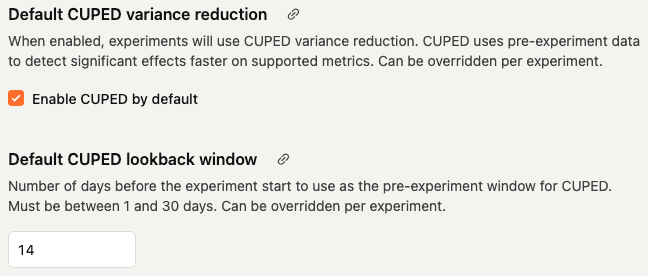
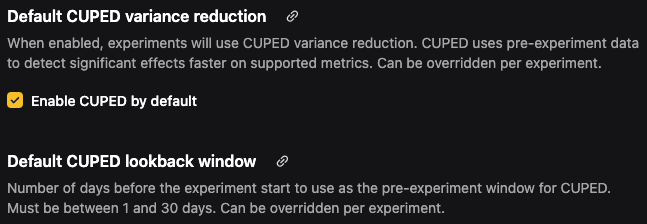
To configure CUPED for a single Experiment, open its Settings tab. You can use the project default or override it for that Experiment.


Why enable CUPED
Enable CUPED when pre-exposure behavior is likely to predict the metric you're testing, such as revenue, usage volume, or activity counts. Stronger correlation means more variance reduction.
When that prediction is useful, CUPED narrows confidence or credible intervals. This can help you detect smaller effects, or reach the same decision with less traffic.
For example, if revenue is the metric, two participants can have the same post-exposure revenue but different baselines. The participant who was low-revenue before exposure gets a higher adjusted metric than the participant who was already high-revenue before exposure. CUPED uses that baseline signal across randomized groups, so predictable differences between participants add less noise to the treatment estimate.
CUPED is less useful when participants have little history or when past behavior doesn't predict the metric.
If there isn't useful pre-exposure data, enabling CUPED usually has little or no effect on the result. The stats engine estimates that relationship; when it's weak, the adjustment is small. CUPED still compares the same randomized groups.
Performance cost
CUPED scans data from the experiment period and the pre-exposure window. This means it has a performance cost compared to analyzing the same metric without CUPED.
Large tests or long look-back windows can take longer to analyze. Use the look-back window setting to control how much pre-exposure data PostHog scans.